WebSocket vs REST API for Market Data: Which Should You Use?
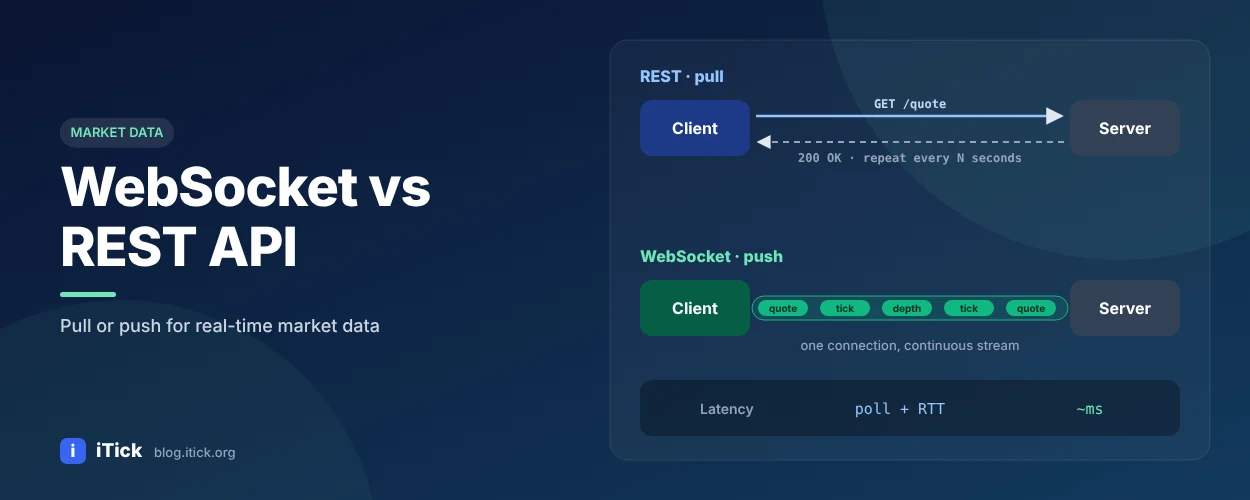
WebSocket vs REST API for Market Data: Which Should You Use?
When you integrate a market data provider you usually get two options: a REST API and a WebSocket API. Both deliver the same prices, but they work very differently - and the choice affects latency, cost, rate limits and how much code you write.
How REST works
REST is request-response. Your app sends an HTTP request ("give me the latest AAPL quote"), the server responds once, and the connection is done.
      Client --GET /stock/quote?code=AAPL--> Server
Client <------------ JSON ------------ Server
To see new prices you must ask again (polling) - every second, every minute, or whenever you need them.
How WebSocket works
WebSocket is a persistent, two-way connection. You connect once, subscribe to symbols, and the server pushes every update as it happens.
      Client ==== connect + subscribe(AAPL, TSLA) ====> Server
Client <=== quote ===  <=== tick ===  <=== depth === Server  (continuous)
WebSocket vs REST at a glance
| REST API | WebSocket API | |
|---|---|---|
| Model | Pull (request-response) | Push (streaming) |
| Connection | New request each time | One long-lived connection |
| Latency | Polling interval + round trip | Milliseconds after the event |
| Efficiency for live data | Wasteful - repeats headers, often returns unchanged data | Efficient - only sends changes |
| Rate limits | Each call counts | Subscriptions, not calls |
| Complexity | Very simple | Needs reconnects, heartbeats, state |
| Best for | Snapshots, history, reference data | Live prices, ticks, order books |
When to use REST
- Historical data: downloading OHLCV candles for backtests (historical data API).
- Snapshots: showing a price once on page load.
- Reference data: symbol lists, exchange info, metadata.
- Low-frequency jobs: end-of-day reports, scheduled scripts.
- Serverless environments that can't hold open connections.
When to use WebSocket
- Live tickers and watchlists that must update instantly.
- Trading bots that react to every trade or quote.
- Order book (Level 2) displays that change many times per second - see Level 1 vs Level 2 market data.
- Many symbols at once, where polling each one would exhaust rate limits.
The hybrid pattern most production apps use
- REST on startup: load history (e.g. the last 500 bars) and an initial snapshot.
- WebSocket for everything after: subscribe and apply live updates.
- REST again after a reconnect: fill any gap that occurred while disconnected.
Python example
      import json
import requests
import websocket  # pip install websocket-client

TOKEN = "YOUR_API_TOKEN"
H = {"accept": "application/json", "token": TOKEN}

# 1) REST snapshot
snap = requests.get("https://api.itick.org/forex/quote",
                    params={"region": "GB", "code": "EURUSD"}, headers=H, timeout=10).json()
print("snapshot:", snap)

# 2) WebSocket stream
def on_open(ws):
    ws.send(json.dumps({"ac": "subscribe", "params": "EURUSD$GB,XAUUSD$GB", "types": "quote,tick"}))

def on_message(ws, message):
    print("update:", json.loads(message))

def on_close(ws, *args):
    print("disconnected - reconnect and backfill gaps via REST")

ws = websocket.WebSocketApp("wss://api.itick.org/forex", header={"token": TOKEN},
                            on_open=on_open, on_message=on_message, on_close=on_close)
ws.run_forever(ping_interval=20, reconnect=5)
WebSocket best practices for market data
- Send heartbeats (
ping_interval) so proxies don't drop idle connections. - Reconnect with backoff and resubscribe after every reconnect.
- Process messages quickly - push heavy work to a queue so the socket isn't blocked.
- Track the last timestamp per symbol to detect and backfill gaps.
- Subscribe only to what you need to save bandwidth and plan quota.
FAQ
Is WebSocket faster than REST? For live data, yes. Updates arrive as soon as they happen, without waiting for the next poll.
Can I use only REST for real-time data? You can poll, but you will add latency, hit rate limits sooner and transfer more redundant data.
Do I still need REST if I use WebSocket? Yes - for history, snapshots and gap recovery.
Get both from one provider
iTick offers REST and WebSocket APIs with the same symbols and JSON schema across stocks, forex, crypto, indices, futures and funds. Get a free API key and try both.